
What Does a Professional Land Surveyor Actually Do?
Most people never think about a professional land surveyor until they actually need one. A neighbor puts up a fence in the wrong spot. A lender asks for a survey before closing. A permit gets held up. Knowing what a surveyor does before that moment can save you a lot of confusion and wasted time.
What Is a Professional Land Surveyor?
A professional land surveyor is a licensed expert who measures land and maps property boundaries. Their job is to figure out exactly where one property ends and another begins, and to put that in writing as a legal document.
In Georgia, every land surveyor must be licensed by the Georgia State Board of Registration for Professional Engineers and Land Surveyors. Getting that license is not easy. It requires a four-year college degree, at least four years of hands-on training under a licensed surveyor, and passing a national exam called the NCEES. After that, surveyors must keep learning every year to stay licensed.
The license matters because survey results show up in deeds, permits, and court cases. A mistake on a survey can cost a property owner thousands of dollars to fix.
What a Land Surveyor Does Step by Step
A survey is not just someone walking around your yard with a tape measure. There are a few clear steps involved.
Step 1. Research Before the Site Visit
Before the surveyor comes to your property, they spend time at their desk doing research. They look up your deed, the plat map for your subdivision, records from neighboring properties, and any older surveys that may exist.
In Atlanta, this often means searching through records at the Fulton County Superior Court Clerk’s office. If your property has old or unclear records, this step takes longer. That extra time shows up in the final quote.
Step 2. Finding Your Corner Markers in the Field
Once the research is done, the survey crew visits your property. Their main job is to find your corner markers. These are metal pins or concrete posts that were placed in the ground during a past survey to mark where your property corners are.
If those markers are still in place and easy to find, the fieldwork goes smoothly. If they are buried, missing, or have been moved by old construction or landscaping work, the crew has to dig deeper to figure out where the corners should be.
Step 3. Checking the Numbers Back at the Office
After the field visit, the surveyor goes back to the office and compares what they measured on your property against what the deed and plat records say. They figure out where the legal boundary lines fall and look for anything that does not match up.
This step is where experience really counts. Reading old records and turning them into accurate measurements on the ground is a skill that takes years to develop.
Step 4. Drawing and Signing the Final Plat
The last step is creating the survey drawing, which is called a plat. It shows your property lines, corner markers, easements, and any encroachments from neighboring structures. The surveyor signs and stamps it, which makes it an official legal document.
According to the American Land Title Association, nearly 40 percent of commercial real estate closings in the United States require a certified survey before the deal can close.
Tools a Land Surveyor Uses
Surveyors today use a mix of older and newer technology to get accurate results.
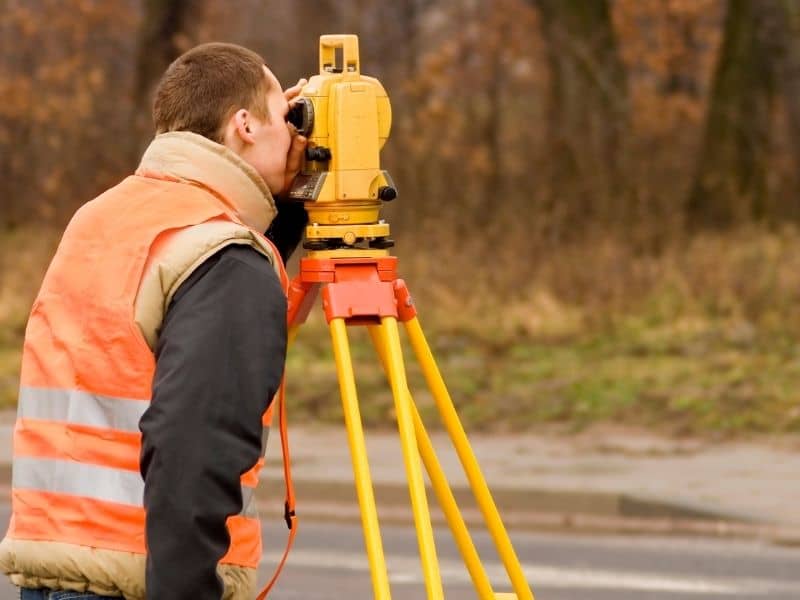
- Total station. This is the most common tool on the job. It measures angles and distances with high precision and is used on most residential and commercial surveys.
- GPS and GNSS receivers. These devices use satellite signals to pinpoint exact locations. They work especially well on large properties where measuring by sight alone is difficult.
- Drone-mounted LiDAR. A LiDAR sensor shoots millions of tiny laser beams at the ground and records where they land. This creates a detailed 3D map of the land below. According to the USGS 3D Elevation Program, modern LiDAR systems can measure elevation to within 1 to 5 centimeters. In Atlanta, where thick trees and hilly ground are common, this tool saves a lot of time on bigger jobs.
When Do You Need a Land Surveyor?
Here are the most common reasons homeowners and buyers hire a licensed land surveyor.
- Your lender or title company asks for a survey before closing
- You want to put up a fence and need to know where your property line actually is
- A neighbor is claiming part of your land
- You plan to build something close to the edge of your lot
- You need a permit from Fulton County that requires a certified plat
- You are buying commercial property and need an ALTA survey for the lender
Fulton County records a large number of new plats and boundary surveys every year through the Superior Court Clerk’s office. That tells you how often surveys are a normal part of buying, selling, and building in the Atlanta area.
