
Boundary Survey Price: Why Your Neighbor Paid Less Than You
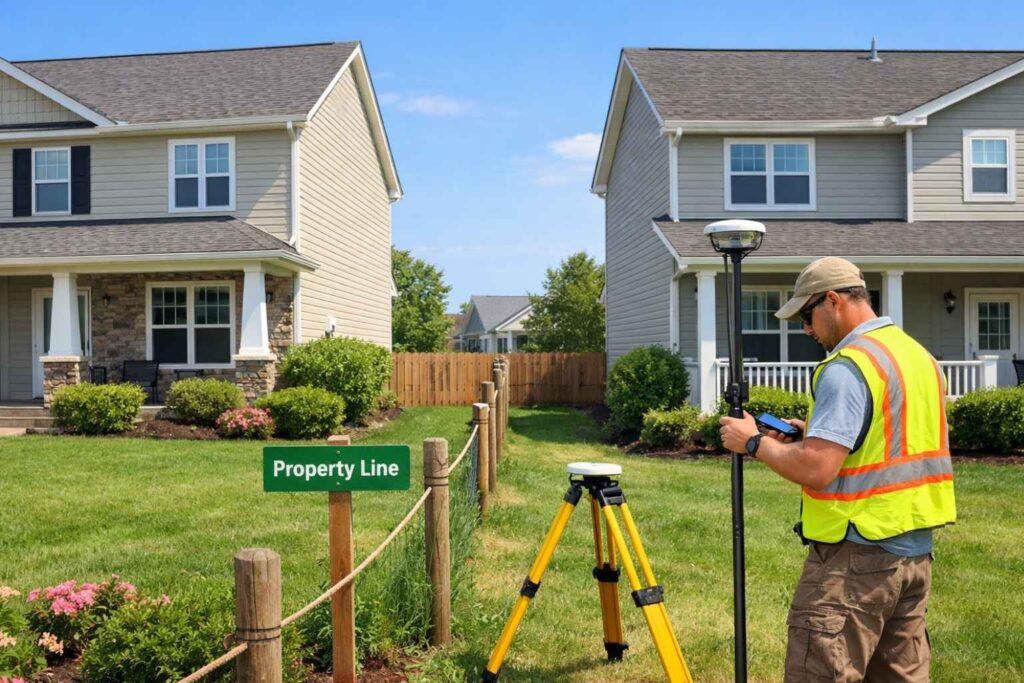
It happens all the time. You ask around before ordering a boundary survey price quote, and someone on your street mentions they paid $600. Your quote comes back at $1,100. Same neighborhood, similar lot size, same firm. What gives?
The answer comes down to what the surveyor actually finds when they start working on your property specifically. Here’s a plain-language explanation of why boundary survey prices vary so much, even between neighboring lots.
Your Neighbor’s Survey and Yours Are Not the Same Job
A boundary survey price is built around the specific conditions of each individual parcel, not a square footage formula or a neighborhood flat rate. Two adjacent lots can present completely different challenges depending on:
- When each lot was last surveyed
- Whether corner monuments are still in place
- What the deed language says and how clearly it matches the plat
- What improvements have been added over the years
- How much vegetation is on the lot
When your neighbor’s survey went smoothly because their iron pins were right where the plat said they’d be and their deed was clean, it was a faster job. If your lot hasn’t been touched since 1978, the monuments have been paved over, and there’s a fence that doesn’t match the record, you’re looking at considerably more work.
The Real Components of a Boundary Survey Price
Understanding the line items behind a boundary survey quote helps you evaluate whether what you’re being charged is reasonable.
Records Research. This is the starting point for every boundary survey. Your surveyor pulls your deed, the recorded plat for your subdivision, neighboring deeds, and any prior survey work on file. In Georgia, this often means searching records through the county recorder, the Georgia Superior Court Clerk’s Cooperative Authority, and in some cases, older courthouse archives.
Properties in Atlanta’s established neighborhoods such as Virginia-Highland, Inman Park, or West End sometimes have deed chains going back generations. Tracing those accurately takes time, and that time is reflected in the price.
Monument Search and Fieldwork. Once the research is done, the crew goes out to look for your corner monuments. If they find all four corners right where the records say they should be, the fieldwork is efficient. If monuments are missing, buried under a driveway, or have been disturbed by past construction, the surveyor has to reconstruct the boundary from surrounding evidence. That reconstruction process is more involved and drives the price up.
Monument Setting. If corners need to be re-established, new iron pins or concrete monuments are set. Some surveys include this in the base price; others bill it separately. It’s worth asking about before you sign a contract.
Plat Drafting and Certification. After fieldwork, the boundary plat is drafted in the office, reviewed for accuracy, and stamped by a licensed land surveyor. This is what makes it a legally valid document. The complexity of the plat, meaning the number of corners, the type of description, and whether any encroachments or easements need to be noted, affects how long this step takes.
Factors That Make Your Price Higher Than Your Neighbor’s
Here are the most common reasons one property in the same neighborhood comes back with a higher quote than the one next door.
Older deed language. Metes and bounds descriptions using old compass bearings, chains, and rods require more interpretation than a modern plat description. If your deed references landmarks that no longer exist (“from the old oak tree”), your surveyor has to work harder to establish the boundary.
Missing corner evidence. Every corner that needs to be re-established from scratch adds time and cost. If your lot has four corners and none of them can be found, you’re paying for four new monuments plus the calculation work to figure out where they go.
Prior encroachments on record. If a previous survey noted a fence line that doesn’t match the boundary, or a structure that sits partially over a property line, that complicates the current survey and usually requires additional documentation.
Wooded or sloped terrain. Heavy tree cover limits the sightlines survey equipment relies on. Hillside lots require more setup points to capture accurate measurements across changes in elevation.
Your property history. Lots that have been split, combined, or had easements added over the years carry a more complicated paper trail. More paper trail means more research time.
How to Get a Fair Price Without Overpaying
A few practical steps that help you evaluate boundary survey quotes:
Get at least two quotes. Prices vary between firms, and a second quote gives you a baseline for comparison. Make sure both quotes are for the same type of survey and the same deliverable.
Pull together your existing documents. Providing your deed, any prior survey, and your title insurance policy upfront saves your surveyor research time. Anything that reduces their office work reduces your bill.
Ask what’s included. Specifically ask whether monument setting, a recorded plat, and a written legal description are included in the quoted price or billed as extras.
Don’t make price the only criteria. A licensed land surveyor who has worked extensively in your area knows the local records, common issues, and how neighboring surveys have been done. That local knowledge is worth something.
FAQ
Why do some firms charge flat rates and others charge hourly?
Both are common. Flat rates work well for standard subdivision lots where the scope is predictable. Hourly pricing is more common on older properties or rural parcels where the amount of research and fieldwork is harder to estimate in advance. Neither approach is better or worse. What matters is that the scope of work is clearly defined before work begins.
Should I be worried if my quote is significantly lower than others?
Worth a closer look. A very low quote sometimes means a narrower scope. Make sure it includes monument setting if needed, a proper plat, and a licensed surveyor’s stamp. Cutting corners on a boundary survey can create bigger problems down the road.
Does the time of year affect boundary survey pricing in Atlanta?
Generally not as dramatically as in northern states, but Georgia’s summer heat and winter rain can occasionally affect scheduling. Periods of very heavy vegetation growth in summer can sometimes slow fieldwork on heavily wooded lots.
How do I know if my boundary survey price is reasonable?
For a standard residential lot under one acre with reasonably clean records, anything in the $600 to $1,200 range is typical. If you’re quoted significantly above $1,500 for a simple subdivision lot, ask for a breakdown of what’s driving the cost.
