
LiDAR Mapping Is Changing Land Surveying. Here’s How
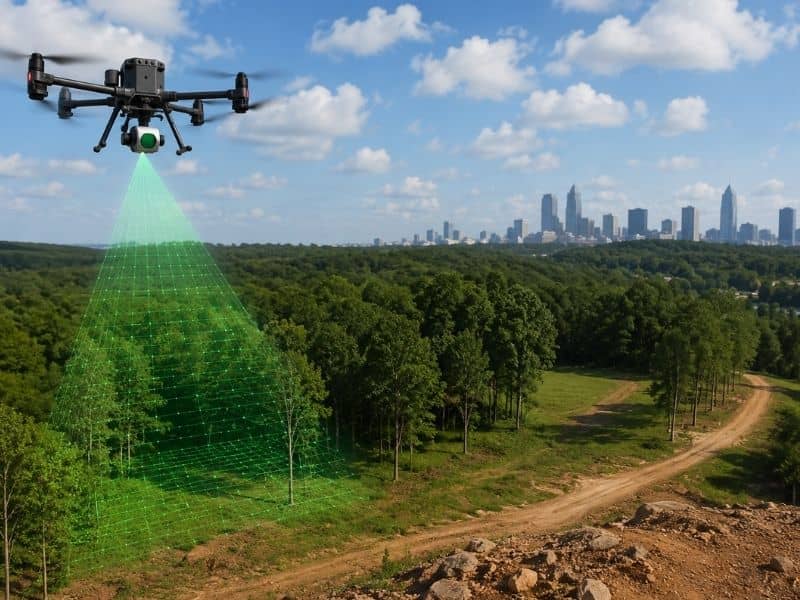
LiDAR mapping is changing the way land surveyors do their work in Atlanta, Georgia, and across the country. You may have heard the term but never knew what it meant.
What Is LiDAR Mapping?
LiDAR mapping uses laser light to measure distances and build a detailed 3D picture of the ground. The system fires millions of laser pulses and records where each one lands. Surveyors use this data to create accurate maps of land, buildings, and terrain.
LiDAR stands for Light Detection and Ranging. Think of it like a very fast, very precise tape measure that uses light instead of a physical tape.
The sensor fires thousands of tiny laser pulses every second. Each pulse travels to a surface, bounces back, and returns to the sensor. The system records how long that trip takes. From that, it can calculate the exact distance to that point.
Do this millions of times across a piece of land, and you get a huge collection of distance measurements. Surveyors call this a point cloud. It is basically a dot-by-dot 3D picture of the area.
How Does LiDAR Work?
LiDAR works by shooting laser pulses at the ground and measuring how long each one takes to come back. A GPS unit records the sensor’s exact location during the scan. Software then takes all those return times and turns them into an accurate 3D map of the scanned area.
Here is something really useful about LiDAR. It can see through trees. Some laser pulses pass through gaps in the leaves and hit the ground below. This means surveyors can map the actual ground surface even under a thick forest. That is very helpful in Atlanta, where trees cover a lot of the land.
According to the USGS 3D Elevation Program, some LiDAR systems can fire up to one million laser pulses per second. That kind of speed makes it possible to map large areas in just a few hours.
How Is LiDAR Used in Land Surveying?
Land surveyors use LiDAR to map large areas of land quickly and accurately. It helps with terrain mapping, construction planning, large property surveys, and drainage work. LiDAR is most helpful on big projects or sites with rough terrain that would take much longer to survey using traditional methods.
Here are the main ways surveyors use LiDAR on real projects:
Terrain and Elevation Mapping. LiDAR collects elevation data fast. It shows hills, slopes, low spots, and drainage paths across a property. Site planners and engineers use this to figure out how to grade a site or manage stormwater.
Construction Projects. Before building starts, LiDAR gives a full picture of the land as it is right now. During the project, it can track how much dirt has been moved. After the build, it helps document what was actually constructed.
Large Land and Road Surveys. Some projects cover hundreds of acres. Others run for miles, like roads or pipelines. A drone with a LiDAR sensor can cover that ground in a single flight. That saves a lot of time compared to walking the whole area with traditional equipment.
Drainage and Water Flow Analysis. In Atlanta, stormwater is a big deal. LiDAR gives surveyors exact elevation data so they can see how water will move across a site. This helps engineers design the right drainage systems before any dirt is moved.
LiDAR Mapping in Atlanta, Georgia
LiDAR mapping in Atlanta, Georgia helps surveyors work through the city’s hilly ground, thick trees, and many streams and creeks. Atlanta is growing fast, and LiDAR helps licensed surveyors collect the accurate data they need for site planning, drainage design, and large construction projects across the metro area.
Atlanta has some tricky land to survey. The city has rolling hills, red clay soil, and dozens of streams running through neighborhoods and open land. It also has a thick tree canopy that covers much of the metro area.
LiDAR handles all of that well. It maps through the trees and captures the real ground surface below. Many counties in Georgia now have publicly available LiDAR data through the USGS 3D Elevation Program. This means surveyors can often start a project with a solid base map already in hand.
The global LiDAR market was valued at about 1.8 billion dollars in 2023. It is expected to grow past 6 billion dollars by 2030. That growth shows how widely this technology is being used across construction, engineering, and land surveying.
LiDAR vs. Traditional Surveying
LiDAR does not replace traditional surveying. It works alongside it. Here is a simple side-by-side comparison:
| Feature | LiDAR Mapping | Traditional Surveying |
| Speed | Covers large areas fast | Takes longer on big sites |
| Data collected | Millions of points at once | One point at a time |
| Works through trees | Yes | Needs physical access |
| Legal boundary lines | Cannot set legal lines | Required for legal plats |
| Best for | Terrain, construction, large sites | Boundaries, lot corners, small parcels |
A licensed land surveyor must still review all data, set property corners, and sign off on any legal survey documents.
Do You Need LiDAR for Your Survey?
LiDAR is a good fit when:
- Your property is over an acre and needs detailed terrain data
- A construction project needs cut-and-fill earthwork calculations
- The site sits near a creek or low-lying area where elevation matters
- The project covers a long stretch of land like a road or utility line
- Heavy tree cover limits the use of aerial photos
For a standard home boundary survey or a small lot survey, traditional methods are usually the better and more affordable choice. Ask a licensed land surveyor which approach fits your project best.
Frequently Asked Questions
What does LiDAR stand for?
LiDAR stands for Light Detection and Ranging. It uses laser pulses to measure distances and build 3D maps of land and structures.
Can LiDAR set my legal property line?
No. A licensed land surveyor must research deeds, plat records, and field evidence to set legal property lines. LiDAR helps support that work but cannot replace the legal process.
How accurate is LiDAR mapping?
Good LiDAR systems can reach vertical accuracies of 1 to 5 centimeters. Accuracy depends on sensor quality, how high the drone flies, and whether proper ground control points were set by a licensed surveyor.
Who can do LiDAR mapping?
LiDAR survey products must be produced by or under the supervision of a licensed land surveyor in Georgia. Make sure your provider is licensed through the Georgia State Board of Registration for Professional Engineers and Land Surveyors.
